


When Kingdoms Collide - Peace on Earth @ MOAH
- Apr 2, 2019
- 3 min read

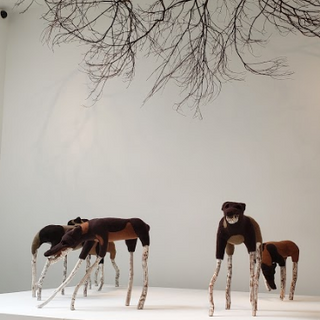
The relationships between people and animals has always been conflicted - but one can be forgiven for forgetting the brutal and exploitative kinship between terrestrial creatures while viewing Peace on Earth, a strange menagerie of eclectic animal art that evokes a surreal merger between the human world and the animal kingdom.
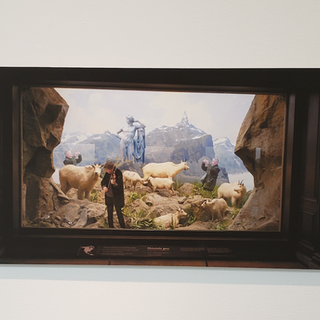
Curated by Andi Campognone, Peace on Earth features the work of 30 incredible artists at the Museum of Art History in Lancaster. As I wandered inside after frolicking in the Superbloom at the Antelope Valley Poppy Preserve, the first thing I noticed was the name of one particular artist: Clayton Campbell, a resident of 18th Street Art Center and a good friend. I immediately recognized his unique digital photo illustrations from his "Wild Kingdom" series that juxtapose human follies with animal dioramas.

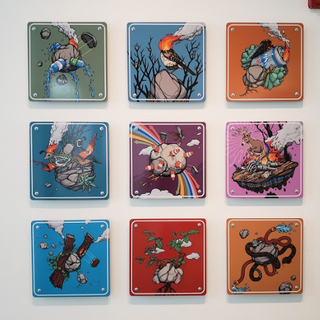
Other artists I recognized in the exhibit were Matthew Floriani, who I met at the stARTup Art Fair at The Kinney in Venice Beach; and Tami Bahat, from her solo show at the Bridges Art Exchange in Bergamot Station.
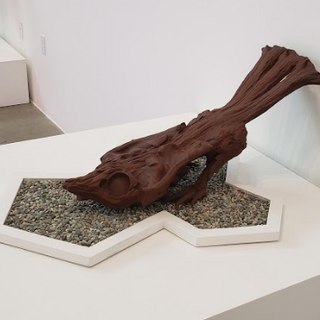
The works in the exhibit are as beautiful as they are brutal - their contexts and connotations relate to issues such as domestication, climate change, extinction, pollution, invasive species, anthropomorphization, fossilization and fantasy.
The piece that stood out to me the most was Laurie Sumiye's collection of videos about the endangered and extinct bird species of the Hawaiian Islands. Growing up in Hawaii, I learned a lot about the history of these bird species through art, and Sumiye's graphic and disturbing films of specimen dissection and detailed deaths of these tiny birds uncovered those childhood memories. One particular puppet musical I remembered from grade school told the story of a flock of five native birds, and how with each wave of human settlement, one of the flock would go extinct -cementing my understanding of mankind's ghastly impact on the natural world.
Another work that evoked those lessons from childhood was Scott Yoell's Sometimes it came by road, othertimes it came by sea, a silicon and resin sculpture of rodents with human noses for heads carrying a tall ship aloft like commoners supporting an Emperor on a litter. This reminded me of the grade-school history lessons where the colonizers came in their ships, bringing vermin, diseases and other such foreign poisons to the pristine paradise that was Hawaii.
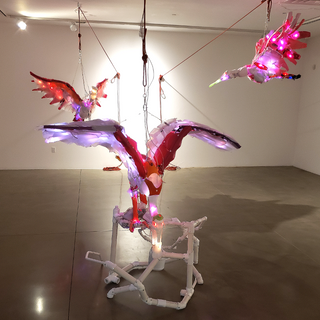
Migrations by Cynthia Minet also recalled my past. With her illuminated sculptures of migrating birds made of post-consumer plastics, I could not help but remember the documentary film Plastic Paradise, where reporter Angela Sun visited the Midway Atolls and uncovered hundreds of dead baby birds whose decaying bodies were full of plastic.

On a lighter note: Simone Gad's whimsical drawings of rescue animals brought a smile to my face. David Thor's abstract Paleolithic creatures reminded me of the sculptures of Yen-Ting Chung, who I had the pleasure of hosting when she was a Artist in Residence at 18th Street.
Finally, I absolutely loved Laurie Hassold's morbid but extremely detailed and evocative mixed media sculptures. As I was taking in every detail, I realized that one of the objects in her sculpture was actually a real butterfly, seemingly emerging from the head of a long dead and fossilized fantastical creature.
With the primordial war between people and animals still raging, this exhibit hints at the hope that, perhaps, peace may be possible yet.














PEACE ON EARTH - Open through April 21st at the MUSEUM OF ART AND HISTORY: MOAH, Lancaster
665 W LANCASTER BLVD. LANCASTER, CA 93534


Comments